The programme
Beyond Vivaldi: the programme
The composers named for the Basílica de la Mercè concert, from Pachelbel and Bach to Schubert, Mozart, Beethoven and Ravel, and where each piece comes from.
Book a seat under the dome ↗Quick answer
Besides Vivaldi, the concert names Pachelbel, Mozart, Bach, Schubert, Beethoven, Handel and Ravel. Programmes change from date to date, so treat the names as the repertoire the concert draws on. The pieces include Pachelbel's Canon, Bach's Air, Schubert's Ave Maria, the Lacrimosa from Mozart's Requiem, Handel's Ombra mai fù and Ravel's Boléro.
Why the programme changes
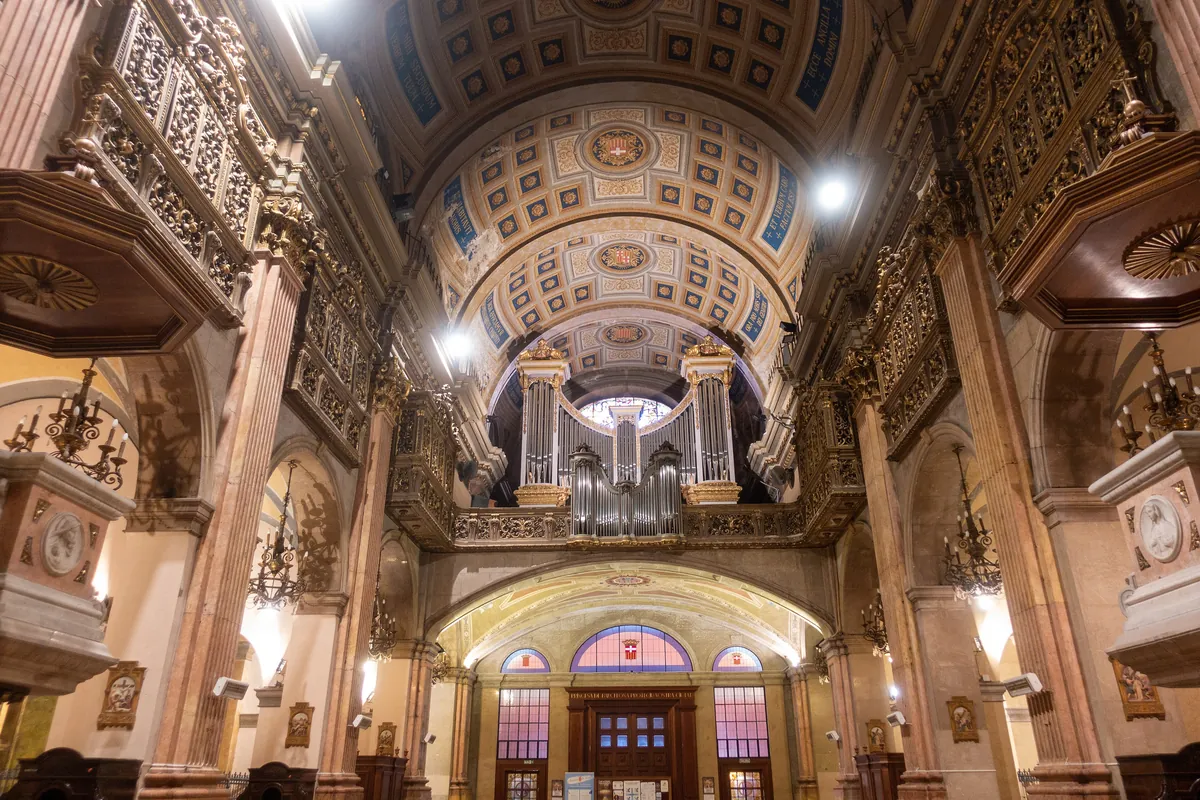
The organiser names a long list of pieces, and a one-hour concert cannot play them all. Programmes can differ between dates, and the calendar entry for your date lists what is planned. Use the list below as a guide to what the concert might hold. Every piece named here is a well-known work, many of them written for other forces, so for strings the arrangement matters as much as the original score.
Vivaldi himself
The concert takes its name from Antonio Vivaldi, born in Venice in 1678, who wrote most of his major works at the Ospedale della Pietà. His Four Seasons appeared in print in 1725, and the programme names the first two, Spring and Summer. Vivaldi's music frames the evening, and the other composers' pieces are chosen to sit beside it. A separate guide explains how the two concertos work.
Read next: Vivaldi's Four Seasons explained
Pachelbel and Bach
Pachelbel's Canon in D was written for three violins and continuo, and it was originally paired with a gigue. Its date is unknown, anywhere from 1680 to 1706, and it became famous after a 1968 recording. Bach's Air comes from his Orchestral Suite No. 3 in D major. It earned the name Air on the G String after the violinist August Wilhelmj arranged it in 1871 for solo violin, moving it to C major so the soloist could play everything on the G string.
Handel and Schubert
The soprano's pieces are the likeliest place to meet these two. Handel's Ombra mai fù comes from the opera Serse, from 1738, where Xerxes admires the shade of a plane tree; the role was written for a soprano castrato, and it is often called Handel's Largo. Schubert's Ave Maria began in 1825 as Ellens dritter Gesang, a song setting a German version of lines from Scott's Lady of the Lake. The Latin prayer words were set to the tune afterwards.
Mozart
The Lacrimosa belongs to Mozart's Requiem in D minor. Mozart's death on 5 December 1791 left the work incomplete, and in this movement his own writing ends after eight bars, with other musicians finishing the score. The organiser also names a Mozart divertimento in D major, a light kind of piece written for entertainment. Mozart's music suits a string group well, and the Lacrimosa in a church is as close to its original setting as most concerts come.
Listening to a mixed programme
A concert that moves from Vivaldi to Ravel crosses about two centuries of music. The earliest pieces, by Vivaldi, Pachelbel and Bach, belong to the Baroque period, the same era as the church. Handel's aria is Baroque too, Mozart and Beethoven belong to the Classical period, Schubert to the early Romantic and Ravel to the 20th century. If you read the programme in order of date, you hear how a single church can host music from very different worlds.
Beethoven and Ravel
Beethoven's Fifth Symphony was composed in 1804 to 1808 and first played on 22 December 1808 in Vienna. The programme names its Allegro, the first movement with the famous four-note opening. Ravel's Boléro dates from 1928 and was commissioned by the dancer Ida Rubinstein; it premiered at the Paris Opéra on 22 November 1928. It repeats one rhythm and grows steadily louder, and a full performance lasts about 15 minutes, so concert versions may be shorter.
Frequently asked questions
Which composers are named?
Vivaldi, Pachelbel, Mozart, Bach, Schubert, Beethoven, Handel and Ravel.
Will every piece be played?
No. The programme changes from date to date, and a one-hour concert cannot hold every piece named.
Sources